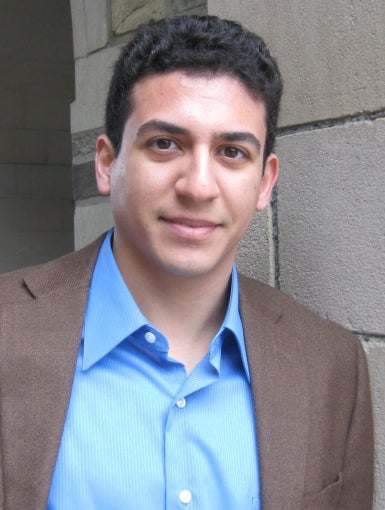
The Constitution is only a few thousand words long, but the way Americans understand it has evolved over time through law, policy and public life. The School of Public Policy and the Maryland Democracy Initiative brought Aziz Rana to campus for a First Year Book event on the U.S. Constitution, where students, faculty and community members considered how constitutional ideas develop and how they are tested over time.
“This year, the first year book for our students is the United States Constitution, a text that continues to anchor our political system while also inviting ongoing interpretation and debate,” said School of Public Policy Dean Gustavo Flores-Macías.
Rana’s remarks engaged students directly with the Constitution, not just as a historical document, but as something that continues to shape public life. He placed the Constitution in a broader context, tracing how Americans have come to understand it not only through its text, but through decades of political decisions, court rulings and public expectations. “We’re living during a moment where… folks that study the Constitution or are lawyers are debating whether or not the U.S. is in a constitutional crisis,” said Rana.
Rana encouraged attendees to look past the usual focus on tension among branches of government and consider whether a shared understanding of the Constitution still holds. “The issue isn’t just a crisis between the branches, but the very way that Americans have come to assume that the constitutional project is consistent, that it’s essentially undergoing threat, breakdown, if not actual collapse,” he said.
Rana described that understanding as a kind of informal compact, shaped over time through landmark legislation, court decisions and shifting public expectations. It ties together ideas about civil liberties, representative government and the role of the state, even when those ideas are not explicitly written into the text. “Change instead takes place through kind of informal shifts in interpretation around the document,” said Rana.
The discussion kept returning to how people engage with institutions and public life. That focus reflects the Maryland Democracy Initiative’s work to build the knowledge and skills needed for civic participation and gave students a way to connect those ideas to current institutions and debates.
Rana closed by returning to the uncertainty shaping the present moment, describing a system under strain without a clear direction for what comes next. “We’re in this moment where the compact is itself far weaker than it’s perhaps ever been… and yet there isn’t really a replacement offer,” he said.
The conversation ended with that tension still in place, alongside questions about what it means for students and others who will take on these roles.