Days after President Donald Trump and Chinese President Xi Jinping met in Washington, D.C., University of Maryland experts gathered at the School of Public Policy for a discussion hosted by the Program on China and the United States on what the summit revealed about the state of U.S.-China relations and what could come next.
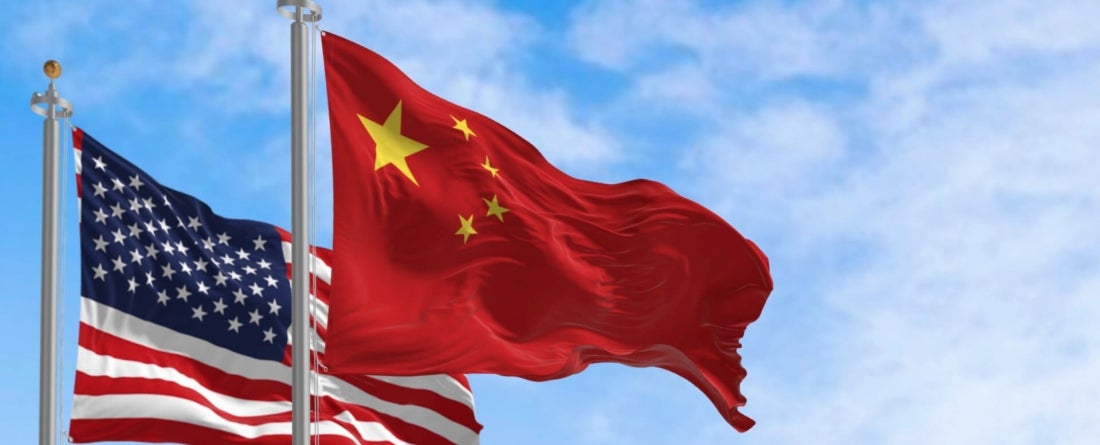
Xi’s September 24 visit to the White House was his first in more than a decade and his third meeting with Trump since the president returned to office. While the summit resulted in movement on trade, emerging technology, counternarcotics and other issues, many of the larger tensions between the two countries remain unresolved.
“I think the takeaway from this meeting was low expectations met,” said Robert Daly, director of the Program on China and the United States (CUSP) at the University of Maryland School of Public Policy. Daly was joined by UMD Department of Government and Politics professors Scott Kastner and Margaret Pearson for the discussion, moderated by CUSP Assistant Director Lucas Myers.
For Daly, a longtime China expert whose career has included work in government and think tanks, one of the summit’s most striking features was how little time the two leaders actually spent in formal talks. Trump and Xi’s scheduled meeting lasted approximately 30 minutes, including interpretation, noted Daly. “This is seen as the most consequential bilateral relationship,” said Daly. “One of the greatest threats to international peace and prosperity is the United States and China getting their relationship disastrously wrong.” The limited meeting time stood in contrast to the breadth of issues dividing both countries, he said.
One of the greatest threats to international peace and prosperity is the United States and China getting their relationship disastrously wrong.Robert Daly Director, Program on China and the United States
Among the summit’s outcomes was a two-month extension of the countries’ trade truce. Both governments also continued work through newly established boards of trade and investment and agreed to create a bilateral dialogue focused on emerging technology. The White House said the two sides discussed Russia, North Korea and Iran and continued talks over rare earths and other critical minerals.
Daly cautioned students to pay close attention not only to announced agreements but also to the language governments use to describe them. Pointing to a proposal for more favorable tariff treatment on $30 billion in non-sensitive goods in each direction, Daly emphasized the distinction between a recommendation and a completed agreement. “Read the wording,” said Daly. That kind of scrutiny is particularly important for future policymakers trying to understand a relationship in which diplomatic signals can differ sharply from underlying strategic realities.
Daly said the warmer tone between Trump and Xi could help lower tensions between both countries. At the same time, he argued that the public display of cooperation should not obscure continued competition over military power, technology, global supply chains and influence around the world. “We can coexist,” said Daly. “It’s not easy. It’s not always fun. But we can do this.”
Pearson similarly focused on the gap between the summit’s symbolism and its substantive results. While the visit generated relatively few major breakthroughs, she said continued leader-level engagement could provide a measure of short-term stability in a relationship marked by longstanding mistrust.
Kastner turned the discussion toward Taiwan, an issue that received considerable attention ahead of Xi’s visit. He said there was no indication following the summit that the United States had changed its longstanding policy toward Taiwan, while questions remain about a pending U.S. arms sales package.
The conversation also moved to questions about America’s alliances, technological competition and the sources of leverage available to both countries. Asked what leverage the United States retains as China exerts its dominance in critical minerals, Daly pointed to U.S. advantages in advanced semiconductors and technology as well as its network of international alliances. Those advantages, panelists said, will matter as competition increasingly extends beyond tariffs and traditional diplomacy into artificial intelligence, supply chains, advanced technology and global influence.
“Study China. Study Chinese. Go to China,” Daly said. “It’s fascinating and extremely important.” The challenge is not simply understanding China or the United States in isolation, but understanding how competition between them is reshaping policy choices far beyond Washington and Beijing.