
Five teams took home awards as the Do Good Institute and Gemstone Honors Program marked a decade of student research built to benefit society.
What do salty farmland, a robotic sea turtle and a bacteria-hunting virus have in common? They’re all subjects of junior Gemstone research aimed at improving life in Maryland and beyond.
The Gemstone Honors Program and the Do Good Institute continued their decade-long partnership, supporting the amplification of the impacts and societal benefits that can grow out of research projects. This year's teams continued the history of doing technically robust research, and also making those research products accessible, understandable, and useful to communities and stakeholders at large.Dr. David J. Lovell Gemstone Honors Program Director
On Monday, November 2, the Do Good Institute and the Gemstone Honors Program hosted the milestone event in Key Hall. Ten student teams presented their research and answered questions from a panel of judges and roughly 200 peers, including first-year Gemstone students getting an early look at the road ahead.
A decade of Doing Good
Ten years in, the showcase still asks Gemstone teams the same simple question: who does your research help? The Gemstone Honors Program is a four-year, multidisciplinary research program for selected UMD honors students of all majors. Small teams design, direct and carry out their own research under the guidance of faculty mentors and Gemstone staff.
By the fall of their junior year, teams are deep into the work. The showcase gives them a chance to step back and explain the bigger picture to an audience that includes judges, faculty and the next generation of Gemstone students.
This year's projects ranged from the Eastern Shore to the ocean floor, to the hospital bedside and beyond. Teams took on saltwater creeping into farmland, the health of seagrass habitats and the global rise of antibiotic-resistant infections.
Do Good Award winners
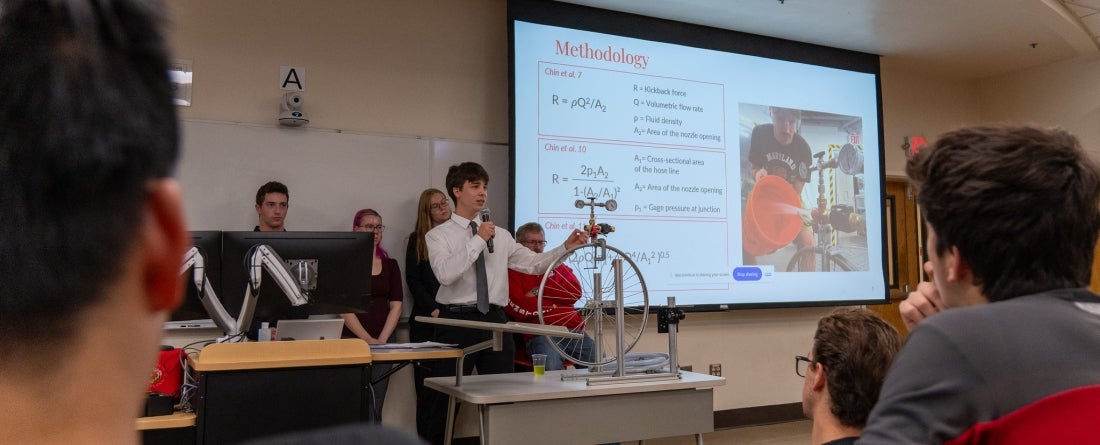
After deliberating, the judges selected three teams, in no particular order, for this year's Do Good Award: AGWA, HYDRA and FIREHOSE. Each team will receive $500 to support its research in the semesters ahead.
- AGWA (Analyzing Groundwater for Agriculture): As sea levels rise, saltwater is seeping into the soil of Maryland's coastal plain and threatening the farms that depend on it. AGWA is using remote sensing, geospatial analysis and predictive modeling to map where farmers are irrigating, forecast how salt spreads through fields and estimate what that means for farm profits and long-term sustainability.
- HYDRA: Seagrass beds are vital underwater habitats, but studying them can disturb the very ecosystems researchers want to protect. HYDRA is building a soft robot, modeled on the way sea turtles swim and made with sustainable materials, that can glide and flap through seagrass while collecting sound, oxygen, water-quality and camera data. The team plans to work with local fisheries and environmental agencies to put the data to use.
- FIREHOSE: FIREHOSE aims to develop a predictive model for firehose kickback force and establish a standardized method for collecting and reporting hoseline data. They seek to answer two key research questions: How can kickback force be predicted under non-ideal conditions and how can current methods of collecting hoseline data be standardized across departments?
Audience Choice Award winners
The crowd had its say, too. BIONIC and BATTLE earned the Audience Choice Award, an honor presented by the Gemstone Honors Program.
- BIONIC: BIONIC focuses on improving upper-limb prosthetics by studying how mental workload and sensory feedback affect how users adapt to myoelectric control. By understanding these factors, we hope to make prosthetic use more intuitive and comfortable for amputees.
- BATTLE: Antibiotic-resistant infections are on the rise worldwide, and phage therapy, which uses viruses that attack specific bacteria, offers a promising alternative. The hard part is finding the right phage for each infection quickly. BATTLE is pairing deep learning and simulation with lab testing to predict the best phage matches sooner, moving toward faster, more personalized treatment.
From protecting Maryland farmland to rethinking how we fight superbugs, this year's teams showed that undergraduate research can start making a difference long before graduation. The Do Good Institute congratulates every Gemstone team for their creativity, persistence and commitment to the public good, and looks forward to seeing where the next decade of research takes them.
Learn more about the Gemstone Honors Program at gemstone.umd.edu. [View photos from the showcase.]